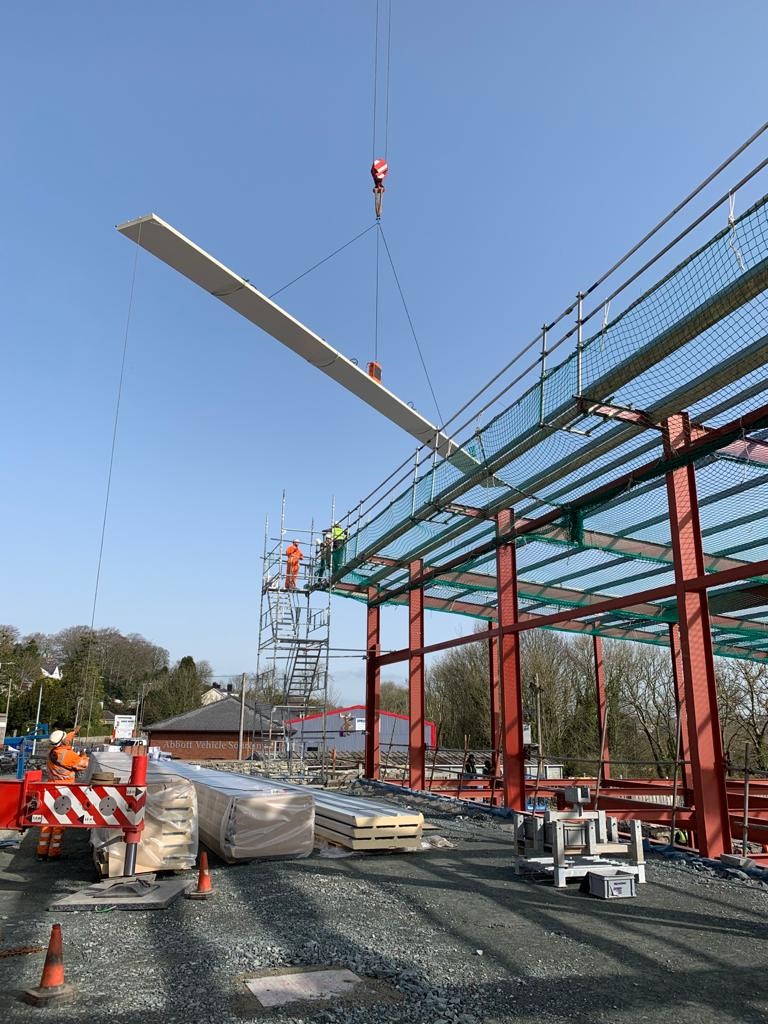
 Shorter VS’s Longer Panels
There are still a lot of envelope contractors who have a preference to using shorter roof panels over longer roof panels.
But what are the benefits of using long roof panels over short panels?
When you step away and consider it, there are a fair few benefits that should be thought about.
There are important points to consider when using long roof panels. You’ll find these details near the end of this article.
Less fixings & sealant
If you think about the amount of fixings needed to fix down a composite panel, you realise that end laps take up a big chunk of fixings used.
If you can minimise the amount of end laps on a roof, you can save a significant amount of fixings needed on the roof.
Every fixing counts, even if they are a couple of pounds in value.
On the same vein, the same applies to sealant.
You must use butyl sealant on the side laps of panels. However, if you remove the panel end laps, you won’t need sealant in that area.
Speed of installation & saving on labour
If you can cut down on the amount of sealant and fixings used on a roof, you will also cut down a lot of the time taken to install the panels too.
The less end laps your roof has, due to using longer panels, the less fixings are needed to be screwed in. Also, the less sealant tape is needed to be laid down which also frees up time.
Using fewer panels on a roof means fewer lifts. This cuts down the number of panels that need to be placed on the roof. As a result, it saves time for squaring, aligning, and fitting them correctly.
The less time spent laying panels and fixing them in to place, obviously means one thing, less labour time used.
Labour costs money, so you can improve your margins by saving installation time on site.
Safety
What is one of the riskiest things about installing roof panels? – craning the composite panels to the roof and moving them in to place on the roof.
When using longer roof panels, you end up doing less lifts.
Reducing the number of crane lifts just reduced the risk of something going wrong.
Hypothetically, if there’s a 1% risk of something going wrong on site. By lifting shorter panels, you may have to end up lifting 100 panels – that’s a risk that during 1 lift, something goes wrong.
In the same scenario but using longer panels, you may be able to reduce the lifts to 50 lifts. This now halves the chance of something going wrong… a bit of a no brainer from a health and saety perspective.
Crane & vacuum lifter costs reduce
Less lifting and faster installation mean your site will need the crane and vacuum lifter for less time.
Less time, means cost savings.
A crane costs a fixed amount each day, whether you’re lifting 5m or 10m panels. If you can cut the lifts in half, you’ll also cut the crane’s need by half on site.
Vacuum lifters like the Clad Boy are a little different. Generally, a vacuum lifter will cost you a bit more per week/day if you are lifting longer panels.
Hiring a Clad Boy for lifting 15m long panels costs more than for 7m long panels. However, this increase is manageable. It still makes economic sense for you as a contractor.
Warranty claims & complaints
Where does water ingress happen on a panel usually? – the end lap.
The less end laps you have n the roof by using longer panels, the less chance you have of leaks.
Fewer leaks mean happier clients. You’ll have fewer warranty problems. This is true for panel makers like Kingspan, Euroclad, and ArcelorMittal.
Things to consider
Longer panels have clear benefits. But they also bring important factors to consider for roofing contractors.
The first is handling & logistics.
Longer panels take up more space. Whether that is on the back of a delivery vehicle (adding to costs), or on site (causing storage issues).
The second is crane-time due to wind sensitivity.
Composite panels can act like sails in the wind. This makes them unpredictable when being lifted. The longer the panels, the more this is exaggerated.
The lift supervisor may stop lifting longer panels sooner than shorter ones when it’s windy. This is done for safety.
The third consideration is tolerance risk.
Steel frames in buildings are built to specific tolerances. By installing shorter panels, it is usually easier to overcome any steel tolerances that are slightly out. Longer panels are a lot less forgiving and any tolerances that are slightly larger will be exaggerated.
Steel tolerance differences might not be your main problem. However, they can still affect your schedule. This may lead to delays on site. This will be your issue as a envelope contractor as this will seen have an impact on other projects etc.
Panel damage is the last consideration
When panels are delivered to site, there’s always a risk that a panel has been damaged during transport. This is part of being an industrial roofing contractor.
If a larger panel is damaged, it affects more roof area than if a smaller panel is damaged.
Get in touch to discuss your panels installation requirements and ensure your project is completed safely, efficiently, and with the right equipment from the start.




